Skip to content


Reports

Report: Reproductive Health of Urban American Indian and Alaska Native Women: Examining Unintended Pregnancy, Contraception, Sexual History and Behavior, and Non-Voluntary Sexual Intercourse This report provides a national picture of reproductive health and sexual violence for AI/AN women living in urban areas. The study is the first to examine data from the National Survey of Family Growth for this population.  Findings show American Indian and Alaska Native women living in urban areas were more likely than non-Hispanic whites to report: non-voluntary first sexual intercourse, unintended and teen pregnancies, unprotected first sex and first sex with older partners.  Rates of female sterilization and use of Depo-Provera were also greater among AI/AN compared to non-Hispanic whites.  An Executive Summary may also be found here. Also see News Coverage. (May 5, 2010).

Report: Urban Indian Health Data System: Envisioning a National Health Information System for Urban Indian Health Organizations There remains much to be done in implementing health information technology (HIT) for improving health services, capturing accurate data for population analysis, and meeting the requirements for securing and retaining resources to better serve the urban American Indian/Alaska Native health community. This report outlines considerations and requirements that will ensure thoughtful implementation of HIT tailored to the needs of organizations individually and across the urban Indian health organizations as a whole. This Robert Wood Johnson Foundation sponsored effort built off the findings of the 2007 Urban Indian Health Commission report, and focuses on the process of defining HIT goals across urban Indian health organizations. (March 2010).

Report: Urban American Indian/Alaska Native Maternal, Infant and Child Health Capacity Needs Assessment The UIHI conducted a Maternal, Infant and Child Health Capacity Needs Assessment to ascertain the maternal, infant and child health (MICH) services as well as the accessibility, quality, and affordability of those services provided by the 34 urban Indian health organizations (UIHO) funded through Title V of the Health Care Improvement Act. The purpose of the assessment was to assist in identifying specific assets, limitations or gaps in the urban Indian health program as a whole. (December 2009).

Report: Visibility Through Data: Health Information for Urban American Indian and Alaska Native Communities This report summarizes information for providers working toward improving the health and well-being of urban AI/AN and is a resource that highlights specific health issues facing this population.  The report includes rank lists of health disparities measured against Healthy People 2010 Objectives, summarizes results from a survey of urban Indian health organization staff, and includes analysis of technical assistance requests that have been received by the UIHI over the past year.  The report is intended to offer guidance on how to use the information for advocacy, funding, and program planning purposes. (August 31, 2009).

Report: Urban Indian Aggregate Diabetes Care and Outcomes Audit Report (2004 – 2008) This report summarizes select measures collected by participating urban Indian health organizations through the annual IHS Diabetes Care and Outcomes Audit.  Information obtained by these facilities and submitted to the IHS Division of Diabetes Treatment and Prevention is used for diabetes surveillance and for helping to create a clinical picture of the AI/AN population who receive care.   The report includes background information on the SDPI, the methods used to collect and analyze the data, aggregate results, and the limitations of the data itself.  It provides a unique opportunity to identify and better understand the health status of urban AI/AN with diabetes and the provision of diabetes-related services to this population. (July 2009)

Report: Urban American Indian and Alaska Native Youth – An Analysis of Select National Data Sources This report provides a review of the urban AI/AN youth population and their health risk behaviors from four national data sources. Where available, census and vital statistics data are provided for the U.S. counties served by the 34 non-profit urban Indian health organizations that contract with the federal Indian Health Service. (March 2009).

Report: Invisible Tribes: Urban Indians and Their Health in a Changing World This report was produced by the Urban Indian Health Commission, a select group of leaders convened by the Robert Wood Johnson Foundation and the Seattle Indian Health Board’s Urban Indian Health Institute to examine health care issues facing urban American Indians and Alaska Natives. (October 2, 2008).

Report: Reported Health and Health-Influencing Behavior among Urban American Indians and Alaska Natives. Findings from the Behavioral Risk Factor Surveillance System, a national telephone survey conducted yearly and coordinated by the Center for Disease Control and Prevention (CDC), show America Indians and Alaska Natives living in selected urban areas were more likely to report difficulty accessing health care, had higher rates of risk behavior, and experienced worse health outcomes than the general population.  Income differences were shown to play a role in explaining some of the health disparities, but differences in some reported health indicators were not income dependent. (March 2008).

Report: Urban Indian Breast and Cervical Cancer Report Baseline data on efforts to provide breast and cervical cancer services for populations of urban American Indian and Alaska Native women. (July 2007).

Report: 2004 Urban Indian Health Status Report At the turn of the 20th century, over one million Americans reporting American Indian or Alaska Native heritage on the 2000 census lived in 34 urban areas which are currently served by Urban Indian Health Organizations, funded in part by the U.S. Indian Health Service. This report briefly reviews selected census, mortality, and birth data in an effort to assess the health status of Urban Indians living in urban Indian health organization service areas. (March 16, 2004).

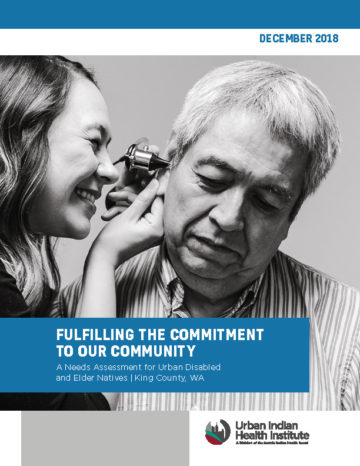
Report: Urban Indian Elders This report describes the methods and results from an assessment of long-term care needs of elders residing in Seattle, King County. The primary goals of the project are to provide characterizing data about the elders, assess current utilization of long-term care services and unmet need for long-term care services. (January 2004).

Reports: Snapshot of Urban Indian Health The purpose of this Issue Brief is to describe the large and growing urban Indian population, their health status, and the major federal health programs (i.e., I.H.S. and Medicare) and federal-state programs (i.e., Medicaid and Child Health Insurance Program) that are available to improve Native Americans’ access to needed health services. In setting forth the circumstances of urban Indians, this Issue Brief does not intend to suggest that the health care needs of Indian people living in rural areas are in any way less compelling. (November 2001).